Baildon Conservative Club Golden Anniversary. 1935.
Click on the image below, or this link, to read a scan of the souvenir booklet or continue reading the extracted text.
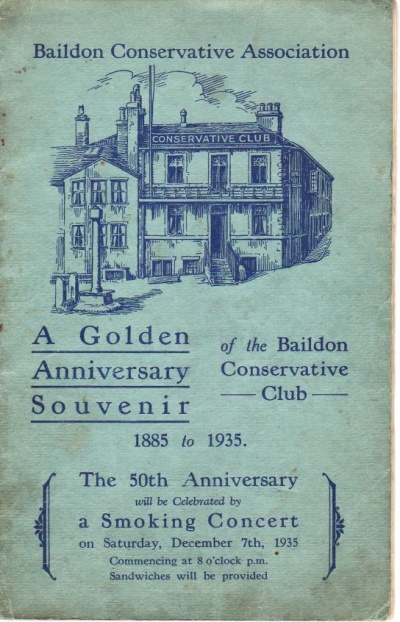
Baildon Conservative Association
A Golden Anniversary Souvenir of the Baildon Conservative Club 1885 to 1935.
The 50th Anniversary will be Celebrated by a Smoking Concert on Saturday, December 7th, 1935. Commencing at 8 o'clock p.m. : Sandwiches will be provided
OFFICERS AND COMMITTEE 1935
Trustees. Mr. JOHN ROBINSON. Mr. MILES RHODES. Mr. JAMES BREAREY. Mr. JOSHUA MANN.
President: H. E. Sucksmith, Esq., J.P
Vice-Presidents: Mr. J. A. GREENWOOD, Mr. GEO. ARMSTRONG, Mr. WM. SOPPITT.
Secretary: Mr. J. WILKINSON
Treasurer. Mr. WM. HALLIDAY.
Chairman : Mr. Geo. E. BIRD.
Vice-Chairman : Mr. W. BALDWIN.
Committee: Mr. W. ADDYMAN, Mr. E. B. COCKING, Mr. S. J. DOLPHIN, Mr. H. JENNINGS, Mr. F. BURGESS, Mr. W. Law, Mr. C. FIRTH
| Year | Name |
|---|---|
| 1885 to 1893 | EDWARD SALT, Esq., J.P. |
| 1894 | GEO. AMBLER, Esq. |
| 1895 and 1896 | T. M. HOLMES, Esq, J.P. |
| 1897 and 1898 | G. C. Wau, Esq. |
| 1899 | EDWARD DOBSON, Esq. |
| 1900 | G. C. WAUD, Esq. |
| 1901 | T. M. HOLMES, Esq., J.P. |
| 1902 and 1903 | HARRY STEEL, Esq. |
| 1904 to 1908 | T. M. HOLMES, Esq., J.P. |
| 1909 to 1911 | R. JOHNSON, Esq. |
| 1912 | H. CONSTANTINE, Esq. |
| 1913 | J. BREAREY, Esq. |
| 1914 and 1915 | HARRY STEEL, Esq. |
| 1916 and 1917 | ERNEST HOLMES, Esq. |
| 1918 and 1919 | J. BREAREY, Esq. |
| 1920 to 1922 | GEO. ARMSTRONG, Esq. |
| 1923 | MILES RHODES, Esq. |
| 1924 | JOS. MANN, Esq. |
| 1925 | J. METCALFE, Esq. |
| 1926 to 1935 | H. E. Sucksmith, Esq., J.P. |
FOREWORD
There are many phases of human activity which spring into existence with the fierce intensity of a devouring flame, burn themselves out in one brilliant blaze, and then recede into the oblivion from whence they came.
There are many, too, which may be compared with a fire which flickers feebly so long as the weather is fair, but is miserably extinguished by the first chill winds of adversity.
Finally there are the select few which can be likened to a fire which burns more steadily, strongly and brightly with each succeeding year, and it is because they are indeed a "select few" that those who bask comfortably in the resultant warmth must now and again give thanks to the pioneers who laid the fire so well, to those who have provided the fuel, and to those who have so carefully tended the flames in the intervening years.
With the arrival of December Tth, 1935, the Baildon Conservative Club becomes one of that proud company of organisations which can look back upon 50 years of continuous existence, and it is fitting that as part of the golden anniversary celebrations the members should look back upon the past, and pay tribute to the efforts which founded a little village club and raised it to the status of an up-to-date, flourishing and progressive organisation with a roll of more than 400 members.
Such is the target at which this little handbook aim.
Baildon Conservative Association 1885 to 1935.
Fifty Years of Progress
The origin of the Conservative Party in Baildon is somewhat obscure, but it is remembered by the older inhabitants, that long before an Association was properly constituted in 1885, Conservatives held meetings at a house in Hall Cliff.
It is also a tradition that for many years previously Tory supporters had met at each others' houses for political discussions.
Political history shows that when the Reform Bill of 1832 increased the popular element in the electorate, the necessity for political organisation began to make itself felt and after the passing of the Redistribution Bill, which added more than two million voters to the electorate, the political parties urged the formation of Associations in townships and villages.
INAUGURATION OF THE BAILDON CLUB
At Baildon, it is recorded, a meeting was held on Monday, December 7th, 1885, at which it was decided to form a Conservative Club. Mr. Jer Garnett presided and Edward Salt, Esq. J.P., was elected President; John Rouse, Esq, and R. C. Lease, Esq., VicePresidents; Wm. Field, Esq., Hon. Treasurer; and T. B. Cawthra, Esq., Hon. Secretary. The following were elected the Committee :— Messrs. T. M. Holmes, S. Halliday, A. Goldsborough, D. Whymark, Richard Bell, R. F. Ingham, J. M. Mann, J. Whatmough, Ellis Halliday, W. Bolton and J. Taylor.
Mr. John Rouse was the chairman at the first meeting of the Club Committee on January 4th, 1886, when it was arranged that the Club should open at 9 am. and close at 11 p.m., and that Wm. Ellis be curator of the Club at a wage of 3/- per week.
POLITICAL OPPOSITION
The formation of the Club evidently aroused some political opposition. Baildon at that time was strongly Liberal, and political views were expressed in no gentle manner.
It is mentioned in the minutes of March 22nd, 1886, that the Committee resolved : "That the top door to the Billiard room be kept locked during the day until six o'clock (except Saturdays) . . . . . some evilly disposed persons having ented the room and marked the billiard cloth with soot."
This wilful damage occurred when the Clubrooms were in Manor Croft, in the building overlooking Kell Cliff. Here the Club rented an upper and lower room.
During 1886 a steady growth in membership is shown and an increase in the curators wage to 5/- per week was made. A subscription of a guinea was paid to the Otley Division Conservative Registration Association and the Club was allowed nine delegates to the General Commitee and one delegate on the Executive.
NEW CLUB PREMISES
Towards the latter part of 1886 negotiations were taking place with a view to purchasing premises for a Club. Finally the cottages in Hall Cliff and the original part of the present building were purchased in 1887. The secretary was instructed to give notice to the Press: "that it was the intention of the Committee to celebrate the Queen's Jubilee by officially opening the new Club, lately purchased."
Private W. Lee, formerly of the Third Hussars, was engaged as curator and reported for duty on September 1st, 1887.
The new curator was known to the members as Sergeant Lee and it was one of his duties to look after payment for billiard games. His favourite expression to members in arrears with these payments was, "You can't play, you're in Balk."
A SOCIAL CENTRE
Probably the most popular events in Baildon at this period, were the annual dances of the various organisations. The Club billiards room was about the only place in the village in which a dance could be held and the Committee had authority to close the Club to members, on eight nights each year for this purpose.
The Conservatives themselves usually organised a Ball on three consecutive nights in November or December. These were very select affairs, for double tickets were 7/6 and single ones 4/-. Baildon Green Cricket Club rented the room for their annual function, which included two nights dancing.
The first mention of a Conservative dance is as follows: "A very successful Ball was held in the billiards room, on September 24th, 1887, when a 20 lbs. ham was cut up for sandwiches." These Conservative functions were held annually for many years, when they unaccountably dropped out of the social calendar.
During the winter of 1889, a second Billiard table was bought and the members of the Club, on December 2nd, 1889, marked its acquisition by holding their first smoking concert.
CONSERVATIVE BAZAAR
The Conservative ladies, even though they had no vote, were anxious to render service to the cause. Early in 1890, they set about the organisation of a Bazaar, which was opened on November 27th, 1890, at the Moravian Schools and lasted for three days.
The Club Committee, expectant of large attendances, resolved that : "The Secretary be instructed to take steps to have the road from Westgate to the Moravian Schools, repaired with ashes or shale. It being very dirty."
Mr. Edward Salt, J.P., the President, was opener on the first day and on the second day, Mr. D'Arcy Wyvill.
The organisers of the Bazaar, by their efforts, were able to hand over to the Club, the magnificent sum of £435.
MEMBERS' DOGS
Throughout the history of the Club, dogs have been a constant nuisance to the members and a source of worry to the Committee.
As far back as 1892, the members petitioned that some action be taken with regard to dogs being brought into the Club. The Committee decided that the rule, made September 6th, 1886: "That no dogs shall be allowed on the Club premises," should be strictly enforced. Many years later—it is on record that a certain dog, named Cinders, was such a good Conservative and regular attender at the Club, that the Committee, to overcome this rule, made Cinders an Honorary Member of the Club. A medal for his collar was engraved bearing the device:— "Cinders, Hon. Member, Baildon Conservative Club" and on the reverse the name of the owner. This loyal dog lived to the ripe old age of 17 1/2 years. As recently as 1933, the rule of 1886 was printed and posted in the Club.
THE BUILDING COMPANY
When the property was acquired for a Club, it was purchased by a group of members styled: — The Baildon Conservative Association Building Co., Ltd., and rent was paid to them.
The Club was making headway, money was in hand from the Bazaar and on July 20th, 1893, the Building Co. was bought out, several members' surrendering their shares to the Club. The premises thus became the property of the Club, being vested in nine trustees, the late Mr. Charles Greenwood, of Baildon Green, holding a mortgage for £600.
THE CONSERVATIVE CLUBS FEDERATION
A movement was afoot in 1894 to restrict the liberties of political clubs and the Baldon Club took an active part in the formation of the Airedale and Wharfedale Federation of Unionist Clubs. This resulted in the alliance of 29 local Conservative Clubs for legal protection, the diffusion of political information, and social intercourse.
With the pressure of work due to the inauguration of the Federation, it seems that the committee neglected the social side of the Club's activities. The annual tea, which had been held regularly in the Church Schools since 1885, was allowed to lapse. At the request of many ladies it was revived in 1896, but after an exceptional blaze of glory for two years it died a natural death.
THE CLUB LIBRARY
At the annual meeting of 1894, Mr. W. Horrocks, was elected the Club's first Librarian. At this time the Club owned a considerable number of books and great interest was taken in them. In 1897 the Library was added to by the purchase of a large number of books from Mr. Geo. Ambler. It is interesting to note that although the Club has now no Library, the present rules provide for a Librarian.
Until removal into the present premises in 1887 the annual subscription had been 4/-, but was then increased to 6/-. The General Meeting of 1896, resolved that "members residing over one mile from the Club should pay an annual subscription of 4/- and the remainder 6/-" The same subscriptions obtain to-day.
CLUB GAMES
The mounting importance of the Club and of Baildon as a political unit may be judged from the fact that the Club, in 1896, had 15 delegates on the Otley Division Conservative Registration Association.
Subscriptions and games were the main source of revenue, the 1898 Balance Sheet shows an income of £164, which included £26/17/- for the sale of tobacco and cigars. Dominoes and Patchesi had been gaining popularity for several years and it is evident that members had been playing for money, although the rules prohibited gambling. It was permissable, however, to play for stakes of cigars or tobacco, and in 1899 the committee posted a notice to enforce the purchase of tobacco immediately after winning games.
Victorian conventions were being slightly relaxed, and in 1900 a meeting of members sanctioned the playing of cards in the Club, by a majority of six votes. It was specified that only whist and solo were to be allowed.
INTRODUCTION OF INTOXICANTS
The year 1901, was a very important milestone in the history of the Club. At the General Meeting it was proposed "That the Club should sell intoxicants." Public opinion at that time considered that it was not quite the thing for a Club, other than an exclusive fashionable Club, to sell liquor. This proposal caused a great controversy. The General Meeting hesitated to deal with this and an extra-ordinary General Meeting was held on February 13th, 1901, to go into the matter.
The proposition put to the meeting was: "That intoxicants be sold in the Club; but not to persons under 21 years of age." After a very heated discussion a vote by ballot was taken which resulted in 32 votes for the sale of intoxicants and 31 votes against — a majority of one! Sixty-five members were present at the meeting, many members did not attend, wishing to keep out of the controversy. The chairman was hostile towards the proposition, but was saved from exercising his casting vote by the majority of one.
AN EARLY BILLIARDS SUCCESS
The introduction of intoxicants into the Club seems to have been the signal for a re-organisation of the Committee for a permanent Chairman and Vice-Chairman were elected and a House Committee formed. The Committee decided that the sale of liquor should commence on March 1st, 1901, and they fixed the price of spirits at 1 1/2d. per small measure and 3d. per large measure.
That year the Club had a first-class billiards team; Mirfield Conservative Club was played at Baildon and at home and the Baildon Club also won the Otley Division Billiards League Cup. It is recorded that the Committee "gave a sovereign towards filling the cup." Visitors from the Ilkley, Otley, Burley, Guiseley, Bingley and Yeadon Conservative Clubs, attended the presentation when a social evening was held.
BAILDON RESISTS BRADFORD
The resignation of the Presidency, by the late Mr. G. C. Waud early in 1901, recalls the attempt by Bradford to absorb Baildon. Mr. Waud was associated with many organisations in Baildon at that time and was the co-opted Chairman of the Council. He was strongly in favour of amalgamation, but Baildon would not have it. Feeling ran very high and ultimately Mr. Waud resigned from everything connected with Baildon, the township thereby losing a great benefactor.
A NEW ERA
Nineteen hundred and one marked the beginning of a new era for the Club. During the year applications for membership increased and the bar accommodation was found to be inadequate. The following resolution appears in the minutes: "That the Bar be moved into the lavatory and the lavatory into the coal-house!" This improvement was carried out, and served the needs of the Club for over ten years, when a new bar was built at the other end of the room.
Some dispute between the Club Committee and the local Inland Revenue Office occurred in 1902. At that time the Revenue Office for Baildon was situated at Bingley and it appears that a demand for male servant duty had been made for the steward. It occurs in minutes that "the Inland Revenue Office cannot induce any payment as we only partly employ curator." This was perfectly true, as the curator, Duke Platt, was in business as a draper in the shop now owned by Mr. F. W. Emmins. There is no further reference to the subject and the inference is that the Committee evaded payment.
CLUB REGISTRATION
Drastic alteration in licensing was taking place during 1902. The Licensing Act was going through Parliament, and the Ace embodied Club Registration. By the Act Clubs selling intoxicants had to be registered. A register of names and addresses of members, and a record of the latest payment of their subscriptions, must be kept in the Club, and the names of guests supplied with liquor must be entered in a book provided for the purpose.
Naturally this caused the Committee much anxiety and repeated efforts were made to collect arrears of subscriptions. The outcome of the Act was to cause the Committee to make a set of new rules to conform with the new Law. The General Meeting of 1903 decided to reduce the number of committeemen to nine and the curator was instructed "not to serve refreshments to anyone who, in his judgment, was not in a fit condition." To show that the Club could do as it liked — up to a point — the meeting decided that the Secretary and Treasurer should be paid £2 for their services, the Auditors should be provided with refreshments while carrying out their duties, and the Curator's wages should be increased to 18/- a week.
"TIME GENTLEMEN, PLEASE" — AT MIDNIGHT!
Nothing of serious moment happened for the next few years, the Club seemed to settle down to a period of prosperity. It was not until 1906 that anything of a controversal nature came before the members. The General Meeting of 1906 discussed the time for closing the bar and after several amendments had been defeated the proposition "that the bar be closed at midnight," was carried! The Committee was the sole authority for granting extensions, which they could grant when and as they thought fit. A proposition, "that an alarum clock be put in the bar, set to ring at midnight," was defeated. Twenty-eight years later the Committee had installed an electric bell to be rung five minutes before closing time.
BETTER FOR BOTH
For several months there had been considerable agitation by a certain section of members for pint glasses. Mr. J. Dyson, a member of the Committee at that time, gives the following information. "The general opinion was that to have pints looked like serious drinking, so a compromise was made by the introduction of a large glass holding one-third of a quart. These glasses were introduced as "Schooners" by Mr. Geo. Robinson, formerly of the Royal Marines, and were known by no other name. A "Schooner" of beer sold at twopence. An amusing story is told by Mr. Jos. Mann (a present trustee) about the pint glass agitation. On asking one of the leading advocates for pint glasses, why he was so keen on having them, Mr. Mann received the reply: "As it is now, when a gentleman asks me to have a drink I can only have a gill, but if we'd pint glasses I could have a pint and that would be better both for the Club and me."
WHEN STRONG DRINK WAS STRONG
With the increasing prosperity of the Club, the Committee were a position to give the members better value for it was decided that : "when breaking down spirits 1 1/2 pints of distilled water be added to each gallon of proof spirit, instead of onc quart which was customary in the trade."
Mr. Jos. Mann supervised the bar and the stock and broke down the various spirits. The small front room was known as the dispensing room and there Mr. Mann had broken down and bottled many a hundred gallons of spirits, which generally tested out at between 14 and 15 underproof. More than twice the strength of spirits sold to-day!
THE DAWN OF PROSPERITY
January, 1907, heralded the dawn of prosperity for the Club; membership was increasing, the bank balance was greatly in excess of current needs and the Committee made the first investment in the Club's history, namely £50.
The thirteen Vice-Presidents for this year gave a cup and two medals to be played for in the Christmas Billiards Handicap and it is recorded that the Committee devoted the whole of the entry fees to supplying Punch for the cup after the final. This instituted the practice of filling the Club's billiard cup with Punch at Xmas. The late Mr. A. J. Robinson was the expert Punch mixer, but with his death the custom seems to have fallen into disuse.
THOSE GOOD OLD DAYS
A movement for the supervision of Clubs selling intoxicants came forward in 1908 and the Committee sent the following resolution to the Association of Conservative Clubs :— "That this meeting pledges itself to resist the imposition of any further restrictions on bona-fide Clubs, deeming the same entirely unnecessary and to support the Association in any and every action it may take to safeguard the just rights and privileges of Clubmen."
In these days of restrictions the foregoing resolution is amusing when it is read in the minutes of the same year, that from December 25th, 1908, to January 2nd, 1909, the Committee decided to grant extensions until 6 a.m. each day.
TROUBLE IN 1909
After the Budget of 1909, much to the disgust of the members, the Committee increased the prices of spirits and tobacco. Spirits were advanced 1/2d. per measure to 2d. and "Players" Cigarettes 1/2d. per packet to 3d.
Towards the end of 1909 some trouble seems to have occurred between the Agent, the Otley Division Association and Baildon. A resolution was sent to the Chairman of Otley protesting against the tone adopted by the Agent towards the Secretary and the workers in the Baildon district and pointed out: "that unless his attitude is changed, the Club will consider the advisibility of withdrawng their support and subscriptions from the Assocation."
THE NEW BAR
For two or three years the necessity for a new bar had become apparent and many schemes had been discussed but no agreement could be arrived at. Finally a special meeting of members was held in February, 1911, at which six schemes were brought forward and voted on. All were eliminated except Mr. J Dyson's and the Committee's schemes. The vote showed an overwhelming majority in favour of the Dyson scheme, the Committee's scheme only getting six votes. The bar was completed the same year at a cost of £47.
CORONATION YEAR
In the February of 1911, the prices of Spirits once more came under review, and, it is interesting to compare present day prices with those fixed at that time :—
| Rum, Gin and unbranded Spirits | 9d. per noggin. |
| White'Labal | 1/- per noggin. |
| Black and White | 1/2 per noggin. |
| Martell *** Brandy | 1/6 per noggin. |
In addition to the new bar further internal alterations were made, the main improvement being the arching of the opening between the old card room and the dispensing room, which is at the present day, the "Domino 'Oil."
To arrange for the Coronation festivities of King George V., the Committee was invited to meet the Baildon Council. The Club took an active part in the arrangements, and it is recorded that the premises were decorated both inside and outside. On Coronation Day an extension was granted till 2 a.m., and much jollification took place.
Apart from ordinary routine work, little of interest is recorded for the next few years, though it is apparent that the Club was struggling. Tariff Reform meetings, under the auspices of the National Conservative League, were held with great regularity in the Club.
THE WAR PERIOD
At the beginning of 1914 it was decided that safety matches should be supplied gratis, in the Cub, for the use of members. This innovation had been brought before the Committee twenty-seven years previously, but had not been granted.
The Committee decided that owing to several members being away on service, due to the War, their subscriptions be remitted while on service and an inter-affiliation ticket given to each of them. This action was confirmed at the Annual General Meeting.
With the coming of "Dora" in 1915, supplies of intoxicants and hours for consuming were curtailed. The Committee introduced the sale of Bovril and Oxo, which was retailed at 3d. per cup and very good business was done.
During 1915, a determined effort by members was made to persuade the Committee to undertake central heating of the Club. This business had been before the Committee since 1911, but finances had not allowed such an ambitious scheme. However it was finally agreed that owing to the war and high prices it should be left until better days.
ON THE ROCKS
A wise decision, as it turned out, for in 1916 most of the members were away at the war and the Club went through a very difficult time. From February to July, 1917, a blank occurs in the minutes. It seems that during this period the Club was without a Secretary. On July 18th, 1917, Mr. James Wilkinson, the present Secretary, was appointed. The Club at that time was "on the rocks" financially and at the year end an adverse balance of £52 was shown. It is gratifying to relate that under Mr. Wilkinson's pilotage, the Club's finances have gone straight ahead, and profits have steadily accrued.
The dark days of the latter part of the War, caused many discomforts and restrictions to Club members.
RATIONS!
In 1918, owing to the fuel and lighting restrictions, the Club was closed at 10-30 p.m. on ordinary days and at 11-30 p.m. on Fridays and Saturdays. So uncertain were supplies of liquor that Whisky was rationed to four small whiskies per day, per member, and the Committee decided that one dozen bottles each of Rum and Whisky should be saved and hoarded for Xmas 1918.
The story is told by the older members, that during the shortage, when a consignment of liquor came to the Club, the news rapidly spread: "There's some ale at the Club to-night." This resulted in a full house, no member wishing to forego his ration.
Nineteen Nineteen, and the War over; a Special General Meeting held in September, decided to go forward with the installation of central heating. This was completed at a cost of £145.
WHICH MAN PAYS?
A rather unusual case came before the Committee in 1920. It appears, that two members drinking together fell out, and each refused to pay for the drinks they were consuming. The curator brought the dispute to the notice of the Committee, which after some discussion, decided that the one who ordered the drinks must pay, failing which he would be supplied with no more liquor in the Club. The member paid!
MORTGAGE PAID OFF
The past 15 years of the history of the Club, is too fresh in the memory of the majority of members to be dealt with at length. It is sufficient to recall the salient points.
In 1922, owing to the rapidly increasing membership, the Green Room was taken into the Club. Previously it had been the bedroom of the cottage below. This improvement was carried out at a cost of some £40.
Towards the end of 1923 the Committee agreed that "the time had arrived when some arrangement could be made to pay off the mortgage on the Club." On June 30th of the following year one month's notice was given to the mortgagee that it would be paid off. It was cleared by the payment of £600 out of Club funds.
From 1926 the policy of the Committee has been to make the premises more comfortable and convenient for members. During that year Electric Light was installed, the bar was enlarged and improved and as the years have gone by the premises have gradually been re-conditioned and modernised.
Nineteen Twenty-eight saw the adoption of the New Rules and Regulations and an investment of £600. Further investments were made as follows:-
| 1929 | £100 |
| 1930 | £400 |
| 1931 | £300 |
THE NATIONAL CRISIS
When Lord Snowden’s Budget was brought in by the first National Government, prices of Beer advanced 1d. per pint. This advance obtained in the Club for a week only, because the Committee, on considering the financial position and the prosperity of the Club, decided that only half of the extra tax should be passed on to the members.
During the third decade of the present century, repeated negotiations had been taking place for the purchase of land adjoining the Club but no suitable arrangement could be arrived at.
Eventually in 1931 it was decided to go forward with a scheme for more accommodation and the new extension was agreed on. The building was completed and furnished at a cost of about £1,700, payment being made out of funds.
The opening of the new extension on December Ist, 1933, was celebrated in suitable fashion.
The question of making the Green Room into a comfortable room had been under discussion since 1925, but in view of the Committee having in mind an extension scheme this was not proceeded with, and it was not until this year that the Green Room was put in order.
SUMMARY
From oil lamps to gas; from gas to electricity; from a small village Club of 30 members, to a Club gradually re-conditioned and almost re-built.
A Club financially sound, with money invested, and more to invest.
A Club to-day with more than 400 members, and each member a co-owner.
Thus we may fairly sum up the first 50 years history of the Baildon Conservative Club.
Celebration
TO CELEBRATE THE GOLDEN ANNIVERSARY OF THE CLUB
A CHILDRENS PARTY will be given in the Church Schools on Thursday. January 2nd. 1936.
Will Members please hand in to the Secretary the names and ages of their children so that invitations may be issued.
A LADIES' NIGHT will be held in the Church Schools on Friday January 3rd, 1936 at 8 p.m.
Refreshments Provided.
Printers
Hartley & Clayton Ltd., Printers, 50, Sunbridge Road, Bradford.


